
The Pocket Bitcoin breach is relatively small by victim count, affecting 291 customers, but the exposed data is unusually sensitive because it connects real identities with cryptocurrency activity. Pocket Bitcoin says private keys were not compromised and customer funds were never at risk, yet leaked support and compliance records included varying combinations of names, postal addresses, Bitcoin addresses, payment amounts, identity documents and source-of-funds information. The risk therefore comes less from immediate wallet theft and more from what criminals can do with a verified identity-to-wallet relationship.
Once a customer’s real identity is linked to a Bitcoin address, attackers gain a useful starting point for blockchain analysis. They may be able to review associated transactions, estimate activity patterns and combine those observations with information from other sources. This does not automatically reveal every wallet or the user’s complete holdings, but it weakens an important layer of practical anonymity and can make targeted attacks considerably easier.
Postal addresses and compliance records increase the risk further because they can support highly convincing phishing, impersonation and even physical targeting. A criminal contacting a victim while knowing their real name, address, transaction amount and wallet information can appear far more credible than an ordinary scammer. Cryptocurrency holders are particularly exposed to this type of targeting because transactions are difficult to reverse once a victim is tricked or coerced into signing them.
The breach also demonstrates why non-custodial architecture and privacy architecture should be treated separately. Pocket Bitcoin’s decision not to hold customer private keys appears to have successfully prevented direct theft of funds. That is a significant security benefit. However, a non-custodial service can still accumulate sensitive metadata about who bought cryptocurrency, which addresses were used and which banking relationships were involved.
The incident therefore raises an important question for cryptocurrency businesses: how much identity-linked transaction data needs to remain available outside the core compliance environment? Pocket Bitcoin initially stated that its principal customer database containing KYC information, Bitcoin addresses and transaction history was not compromised. Subsequent investigation found that some of the same information had nevertheless been copied into support correspondence and communications with partner banks.
That is a classic example of sensitive-data sprawl. An organization may strongly protect its primary KYC database while lower-trust systems gradually accumulate screenshots, documents, transaction details and correspondence containing the same sensitive information. Security controls then follow the application label rather than the actual data.
Crypto companies should therefore identify where identity documents, wallet addresses and financial records are duplicated across support platforms, email systems and banking workflows. Sensitive attachments should be removed when no longer required, access should be role-based, and retention periods should reflect legal necessity rather than operational convenience.
Data Loss Prevention and automated classification can help identify this drift. A support system containing identity documents or wallet addresses should not automatically be treated as low sensitivity simply because its primary function is customer service. The protection level should follow the most sensitive information stored there.
The incident also reinforces the value of limiting staff access. Support employees may need enough information to resolve a transaction issue, but they rarely need unrestricted visibility into complete KYC documentation and all related wallet activity. Applications can expose only the fields required for the case while keeping raw compliance records in a more tightly controlled environment.
The same principle applies to integrations. API keys and service accounts connecting support, banking and compliance platforms should be narrowly scoped and monitored. One compromised help-desk credential should not provide a path into the entire identity-verification or transaction-history environment.
For affected customers, the practical risk is now social engineering. Any communication referencing genuine transaction details, wallet addresses or identity information should be treated cautiously because those details may no longer prove that the sender is legitimate. Attackers may impersonate Pocket Bitcoin, banks or other cryptocurrency services and use accurate leaked information to persuade victims to reveal recovery phrases or authorize transactions.
No legitimate service should request a wallet seed phrase or private key as part of breach remediation. Users should independently verify communications through established channels and be particularly cautious about urgent requests to “secure,” “migrate” or “verify” funds.
Organizations should update their own support procedures for the same reason. If information such as postal addresses, recent transaction amounts or wallet addresses was exposed, those fields should no longer be treated as strong evidence of customer identity during account recovery or support interactions. Breach response should change trust assumptions, not merely reset credentials.
The blockchain dimension also means the effects may outlast the original incident. Historical transaction data cannot be removed, and continued reuse of exposed addresses may provide additional information over time. Users whose addresses were included in the breach should therefore assume those addresses are now publicly attributable and avoid treating them as pseudonymous going forward.
This does not mean users should move funds impulsively. Poorly planned transfers can create additional on-chain links. The appropriate response depends on wallet structure, address reuse and operational security rather than simply sending everything to a new address.
For higher-value holders, privacy should be considered alongside key protection. Hardware wallets remain essential, but reducing public association between identity and holdings, avoiding unnecessary disclosure of balances and using appropriately designed multi-signature arrangements can lower the consequences of targeted attacks.
The incident also provides a useful lesson for KYC-heavy cryptocurrency services. Compliance obligations may require identity collection, but they do not require unlimited duplication. The more systems that contain the link between customer identity and blockchain activity, the greater the number of places an attacker can obtain it.
Privacy-preserving design should therefore focus on minimization, separation and controlled access. Raw identity documents should remain in the narrowest possible environment, support systems should receive only what they need, and records should be removed when retention is no longer legally or operationally justified.
Pocket Bitcoin says it has completed its investigation, fixed the underlying issue, notified affected customers individually, reported the incident to Switzerland’s data-protection authority and filed a police report. It also says there is currently no indication that the exposed information has been misused. That is encouraging, but stolen identity information can remain useful long after the technical vulnerability has been closed.
The broader lesson is straightforward. Self-custody protected the assets, but it could not protect the metadata surrounding them. Cryptocurrency services therefore need to secure not only private keys, but also the systems that connect real people to public financial activity.
For users, the same principle applies: protecting the wallet is essential, but protecting the relationship between your identity and that wallet is part of security too.
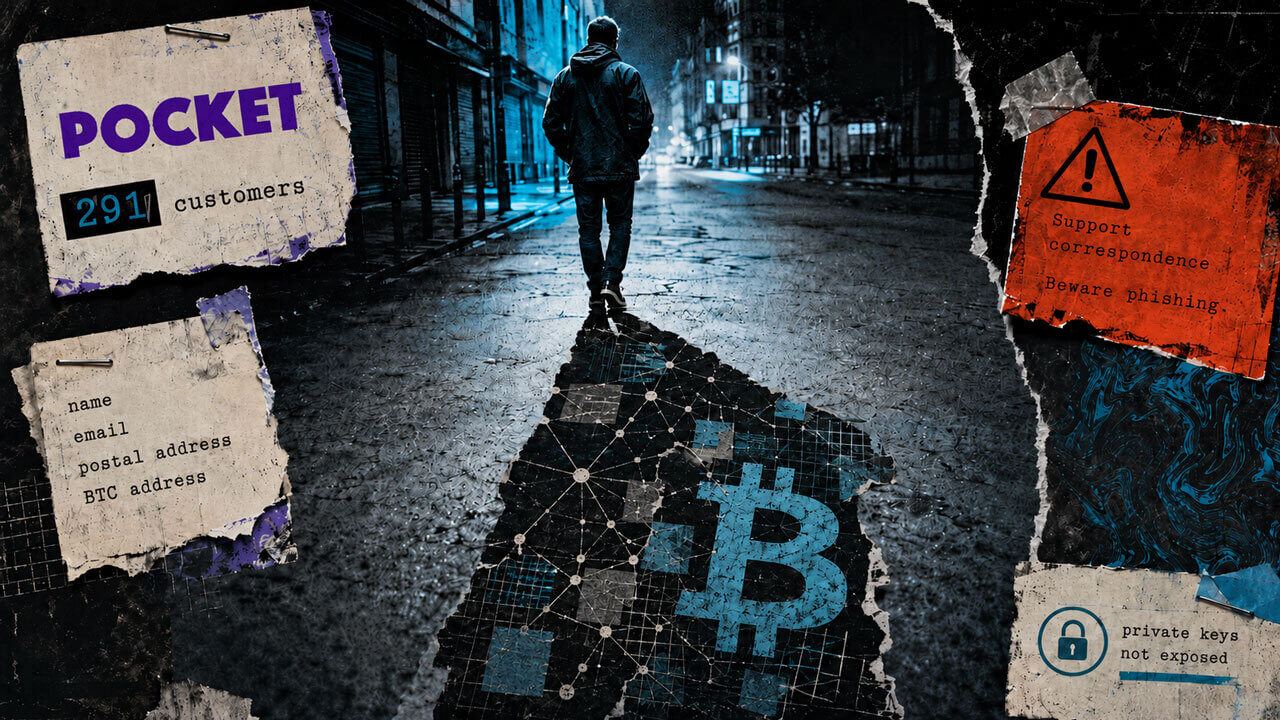
The Pocket Bitcoin breach exposed identity, location and compliance records for 291 customers, but private keys and funds remained safe.
Source: Leaked compliance records shatter anonymity of 291 crypto users by matching names directly to wallet activity via cryptoslate.com.
Was this article helpful?
Your feedback helps us improve the knowledge base.