
The critical vulnerability CVE-2026-58231 affecting SAP Commerce Cloud demonstrates how a weakness in application-level authorization can become considerably more dangerous when it intersects with default authentication configuration and insufficient input validation. The vulnerability affects the Data Hub Adapter component of SAP Commerce Cloud and has received the maximum CVSS score of 10.0. According to SAP, an unauthenticated attacker can abuse a default authentication client and submit specially crafted input to application functions that do not perform sufficient validation. Successful exploitation can lead to arbitrary code execution and compromise internal components of the Commerce Cloud application, potentially affecting the confidentiality, integrity and availability of the entire environment.
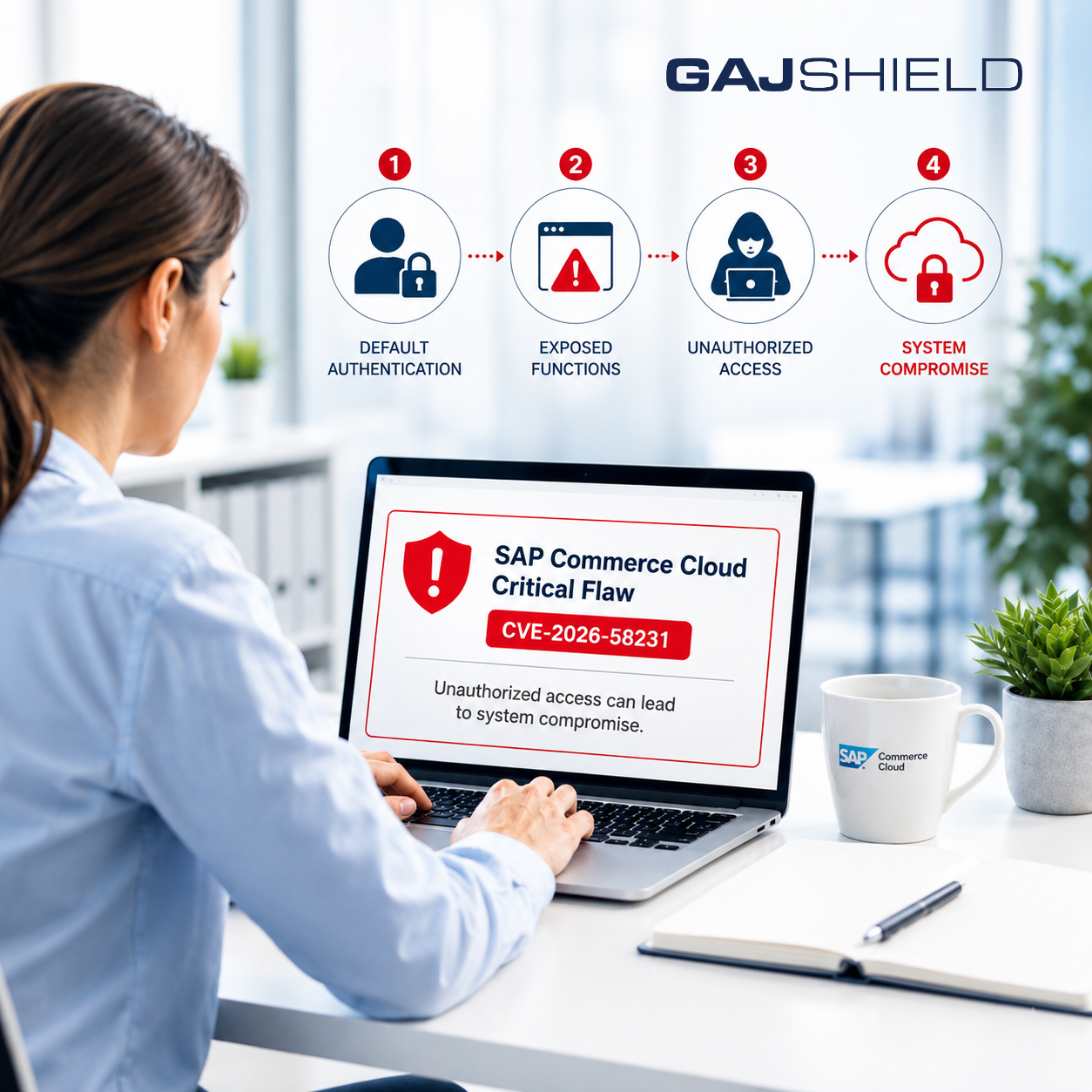
The most concerning element of the vulnerability is that exploitation does not require the attacker to possess a legitimate customer or administrative account. The weakness effectively allows an external attacker to cross an authorization boundary that should have prevented access to sensitive functionality in the first place. Once crafted input reaches the vulnerable processing path, the failure of input validation can then transform unauthorized access into code execution. This combination of authentication weakness and unsafe processing explains why the vulnerability receives the highest possible severity rating.
SAP Commerce Cloud is not simply a public-facing website. In many enterprises it forms part of a larger commerce architecture connected to product information, customer databases, order-management platforms, payment services, inventory systems, CRM platforms and integration middleware. Remote code execution within such an environment can therefore become significantly more serious than compromise of an isolated web server. Attackers may gain an opportunity to access credentials, application configuration, integration secrets or internal network resources that the commerce platform legitimately uses.
This is why internet-facing enterprise applications need to be evaluated according to the trust relationships behind them rather than merely according to the information visible through the frontend. The public storefront may display products and shopping carts, while the application behind it communicates with considerably more sensitive systems. Compromising the application server can potentially turn legitimate integrations into attacker-controlled pathways toward those systems.
The vulnerability also illustrates the security risks created by default authentication clients. Default accounts, sample credentials and predefined authentication objects are convenient during installation and development because they make it easier to get systems operating quickly. The danger begins when these defaults remain accessible in production and become part of the application’s trusted authentication model.
Security architecture should assume that any credential, client identifier or default configuration distributed publicly with software will eventually be known to attackers. Public documentation is not secret material, nor should it need to be. Production security must depend upon unique credentials, correctly configured authorization and server-side validation rather than hoping attackers do not discover default values.
The strongest design is therefore one in which possession or knowledge of a default authentication client provides virtually no useful privilege. Sensitive application functions must independently verify whether the requesting identity is authorized to perform the requested operation. Authentication answers who is making the request; authorization must separately determine whether that identity should be permitted to perform the action.
CVE-2026-58231 demonstrates the consequences when those boundaries are not sufficiently enforced. An attacker can reach functionality that should not be available anonymously and then provide specially constructed input capable of influencing application execution. Once attacker-controlled data begins affecting server-side execution, the compromise can move beyond unauthorized API use toward arbitrary code execution.
Remote code execution should be treated as potential server compromise rather than merely application compromise. Depending upon the privileges assigned to the affected service, attackers may be able to read files, inspect environment variables, access application credentials, communicate with backend systems or install persistence. The exact post-exploitation possibilities depend on each customer’s deployment architecture, but defenders should plan for the possibility that an exploited application server can no longer be trusted.
Organizations should therefore avoid limiting their response to upgrading the vulnerable software. If the vulnerable endpoint was externally accessible before remediation, security teams should investigate whether exploitation may already have occurred. Application logs, authentication records, unusual API requests, outbound connections, unexpected processes and changes to application files should be reviewed around the suspected exposure period.
Outbound traffic deserves particular attention after server-side code execution. A compromised Commerce Cloud instance may attempt to retrieve additional tools, communicate with command-and-control infrastructure or access internal services that it normally does not contact. Egress filtering can therefore provide both containment and detection even when the initial vulnerability exists in an internet-facing application.
Application servers should not have unrestricted outbound internet connectivity merely because they occasionally need to reach external services. Destinations required for payment processing, software repositories or specific APIs can be allowed explicitly, while unusual connections toward newly registered domains or arbitrary internet hosts should generate investigation.
Internal segmentation becomes equally important. The Commerce Cloud application should communicate only with backend services required for its business function. A compromised storefront should not be able to scan the corporate network, connect directly to administrative systems or reach unrelated databases simply because everything resides within the same cloud environment or virtual network.
Database access should follow the same principle. Commerce applications should use dedicated service identities with only the database permissions necessary for normal operation. If the application is compromised, excessive database privileges dramatically increase the amount of customer and transactional information attackers can retrieve or modify.
Secrets management can substantially reduce the downstream impact of code execution. API credentials, database passwords and cloud tokens should not be embedded directly in source files or static configuration where an attacker who gains filesystem access can immediately retrieve them. Dedicated secrets-management platforms and short-lived credentials make application-server compromise less useful.
Cloud identity permissions require similar scrutiny. If SAP Commerce Cloud workloads interact with other cloud services using machine identities, those identities should receive narrowly scoped permissions. A compromised workload should not inherit broad subscription-level or tenant-level authority simply because assigning one powerful service identity was administratively convenient.
Web Application Firewall controls may help detect or block certain exploit attempts, particularly once reliable indicators become known, but they should not be considered a permanent substitute for correcting the vulnerable application. Input-validation flaws can often be triggered through multiple encodings or request variations, and attackers routinely adapt payloads to bypass pattern-based filtering.
SAP and Onapsis recommend that customers patch to a fixed Commerce Cloud release and rebuild and redeploy the application. The rebuild and redeployment requirement is important because cloud application updates may not become effective merely because the underlying platform has received new components. Customers need to ensure that their own deployed application incorporates the corrected Commerce Cloud version.
Organizations should verify the actual runtime version after deployment rather than assuming that a completed CI/CD job proves remediation. Asset and software inventory should identify which production, staging and disaster-recovery environments still contain affected Commerce Cloud versions. Internet-facing test environments deserve particular attention because they frequently receive weaker monitoring while containing realistic configurations and data.
Where an immediate upgrade cannot be completed, an IP Filter Set can temporarily restrict access to the vulnerable endpoint. Such a control can reduce the number of systems capable of reaching the vulnerable functionality, particularly when only known backend or administrative services require access. However, temporary network restrictions should have an explicit expiry and remediation owner so they do not quietly become the permanent solution.
The vulnerability also reinforces the importance of minimizing publicly reachable application endpoints. Modern enterprise applications expose large numbers of APIs, administrative functions and integration interfaces, some of which may have been enabled for historical reasons but are no longer required. Organizations should continuously inventory externally reachable endpoints rather than assuming the public storefront is the only part of the application visible from the internet.
API discovery becomes especially important because attackers increasingly target undocumented or forgotten endpoints. An endpoint does not become safe merely because users cannot reach it through the normal graphical interface. Automated scanners and attackers interact directly with HTTP routes and APIs without caring whether the application provides a button leading to them.
Server-side authorization therefore needs to exist on every sensitive function. Relying on frontend controls, hidden menu options or assumptions about which sequence of requests a normal client will send provides little protection against attackers constructing HTTP requests manually.
Input validation should similarly occur at the point where data enters the trusted processing boundary. Applications need clear schemas specifying acceptable type, length, format and structure rather than attempting to identify known malicious strings after the fact. Data that does not match the expected structure should be rejected before it reaches interpreters, templates or other sensitive processing components.
The SAP vulnerability is also another reminder that authentication mechanisms themselves should be included in application security testing. Penetration tests frequently concentrate on common web weaknesses such as injection and cross-site scripting while treating OAuth clients and machine-to-machine authentication as infrastructure configuration. In enterprise applications, those identities can represent some of the most powerful trust relationships available.
Security testing should ask whether default clients exist, which scopes they receive, whether their secrets are unique, which APIs they can invoke and whether backend authorization independently verifies each operation. Automated configuration analysis can help detect development defaults that accidentally survive promotion into production.
Organizations running SAP platforms also need a rapid process for handling SAP Security Patch Day because enterprise systems can be difficult to update. Commerce systems frequently contain customization, integrations and business-critical workflows that make administrators understandably cautious about changes. Unfortunately, attackers are not required to respect the enterprise testing schedule.
Maintaining representative staging environments and automated regression testing makes emergency security deployments considerably safer. Commerce organizations should be able to verify checkout, integrations and customer workflows rapidly after security updates rather than choosing between extended vulnerability exposure and uncontrolled production change.
The August 2026 SAP Patch Day demonstrates why that capability matters. SAP released numerous security fixes, including several critical vulnerabilities across Commerce Cloud, Manufacturing Integration and Intelligence, NetWeaver and ABAP environments. Security teams therefore need a structured process capable of evaluating multiple urgent SAP vulnerabilities simultaneously rather than addressing them as isolated tickets.
CVE-2026-58231 should receive particularly high priority because it combines internet accessibility, lack of authentication and arbitrary code execution. Organizations should identify affected Commerce Cloud 2211 and 2211-JDK21 deployments, apply the corrected release, rebuild and redeploy the application, and verify that vulnerable endpoints are no longer exposed.
Where the affected environment was reachable externally, defenders should also review historical activity rather than treating patch installation as proof that no compromise occurred. Unexpected application requests, new files, unusual processes, outbound network activity, changed credentials and abnormal access to backend systems should all form part of the investigation.
Potentially exposed application secrets should be rotated if forensic evidence indicates exploitation or if compromise cannot be excluded confidently. Attackers who obtained credentials before the update can continue using them after the vulnerable code has been removed, making secret rotation an essential part of containment where compromise is suspected.
The broader lesson is that authorization, input validation and secure defaults are not independent security features. They reinforce one another. Proper authorization prevents untrusted users from reaching dangerous functions, input validation limits what authorized users can supply, and secure configuration prevents default identities from becoming shortcuts around those controls.
When several of those protections fail simultaneously, a seemingly ordinary application endpoint can become an unauthenticated remote-code-execution path.
For enterprises, the security objective should therefore extend beyond patching this particular CVE. Internet-facing business applications should be designed so that even if one authentication mechanism fails, authorization still limits access; if authorization fails, strict input validation still limits processing; and if code execution ultimately occurs, segmentation and least privilege still limit the blast radius.
CVE-2026-58231 is critical because multiple defensive assumptions can collapse together. The strongest architecture is one where they cannot all collapse at once.

SAP has released patches to address a maximum-severity security flaw impacting Commerce Cloud (Data Hub Adapter) that could result in arbitrary code execution. The vulnerability, assigned the CVE identifier CVE-2026-58231, is rated 10.0 on the CVSS scoring system. It has been described as a case of insufficient authorization checks and input validation. "SAP Commerce Cloud allows an
Source: SAP Commerce Cloud Flaw Could Let Unauthenticated Attackers Execute Arbitrary Code via The Hacker News — published 12 Aug 2026.
Was this article helpful?
Your feedback helps us improve the knowledge base.