
The discovery of 15 vulnerabilities affecting TP-Link’s Omada Zero-Touch Provisioning ecosystem demonstrates how technologies designed to simplify network deployment can create extensive security risks when the initial chain of trust is not properly protected.
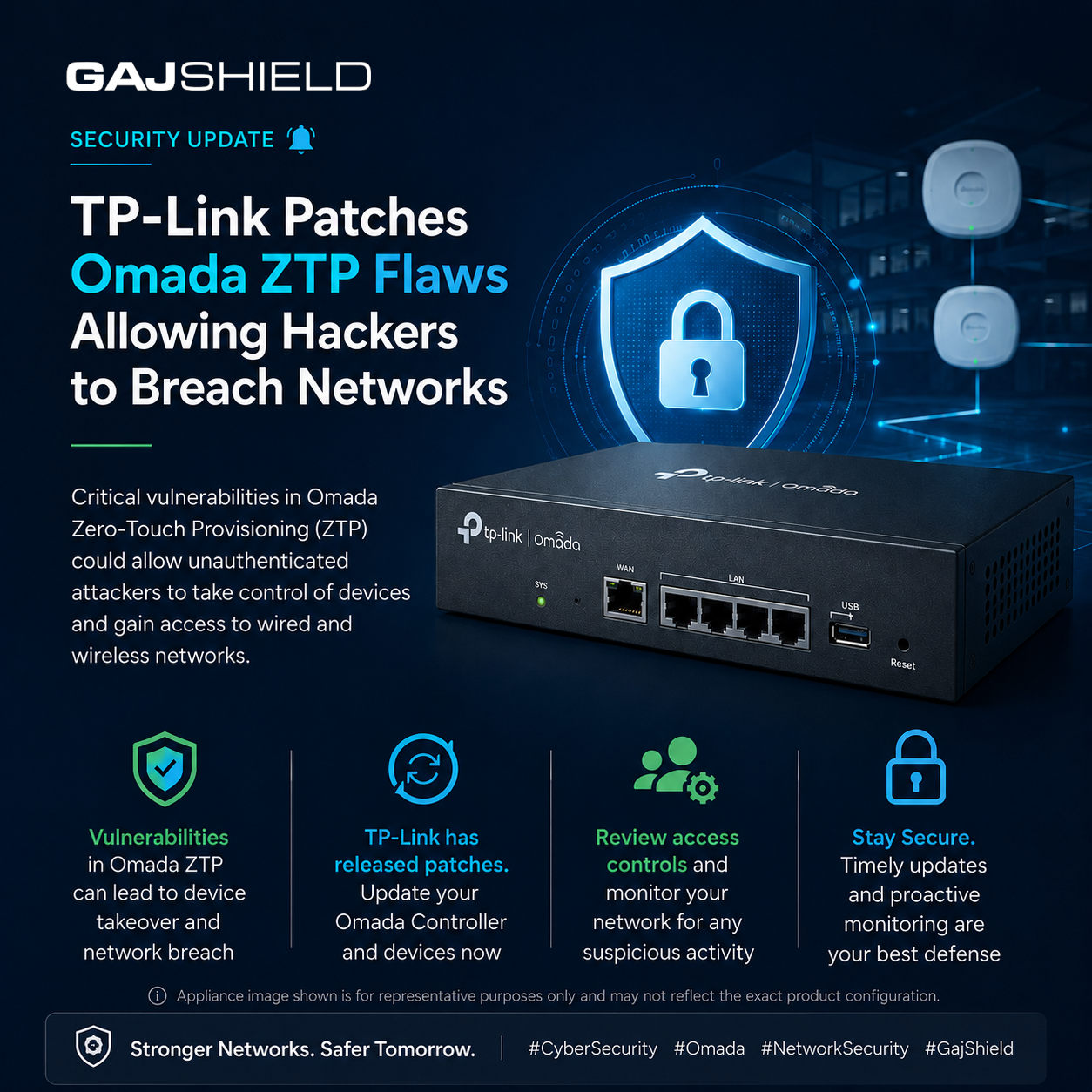
Zero-Touch Provisioning allows organizations and managed service providers to deploy routers, switches, wireless access points, gateways and other network devices without manually configuring each system at the installation site. A newly connected device can identify its controller, authenticate with it and automatically receive network settings, administrative credentials, VPN configurations and firmware updates.
This process substantially reduces the time and cost involved in deploying equipment across offices, branches, warehouses, residential complexes and distributed customer environments. However, it also requires the device and controller to trust each other before the device has received its final security configuration.
The vulnerabilities identified by Forescout’s Vedere Labs affect several stages of this initial trust process. Researchers found weaknesses involving device identification, authentication, certificate validation, cryptographic keys, credential handling, cloud adoption and management interfaces.
When combined, these issues could allow an attacker to impersonate a legitimate Omada device, interfere with the adoption process, obtain sensitive configuration information and eventually gain access to the networks managed through the Omada controller.
The incident demonstrates that Zero-Touch Provisioning should never be interpreted as Zero-Trust Provisioning. Automation can remove manual configuration work, but it cannot remove the need for secure device identity, protected credentials and independently verified communication.
The vulnerabilities affect the wider Omada ecosystem
The research does not describe one isolated defect affecting a single router model. It identifies weaknesses across several components of the Omada management and provisioning ecosystem.
Affected technologies include selected Omada hardware, software and cloud controllers, gateways, switches, wireless access points, optical line terminal platforms, cloud services and mobile applications. Some of the underlying trust and certificate-validation issues also affect other TP-Link product families, including Festa networking equipment, VIGI surveillance systems and several consumer mobile applications.
This broad scope is important because centralized network-management ecosystems often reuse authentication, cryptographic and cloud components across multiple products.
Reusing common infrastructure improves development efficiency and provides a consistent user experience, but it can also create concentration risk. A weakness in one shared certificate, private key or protocol implementation may affect several otherwise separate products.
Organizations should therefore avoid assuming that updating only the Omada controller resolves every relevant exposure. The complete environment must be reviewed, including managed network devices, mobile applications, cloud accounts and related TP-Link platforms using the same underlying trust mechanisms.
Predictable serial numbers could expose devices awaiting adoption
One part of the demonstrated attack chain involved enumerating predictable device serial numbers through the Omada cloud interface.
An attacker who guesses or enumerates a valid serial number may be able to obtain the corresponding MAC address and determine whether the device is waiting to be adopted by a controller.
Serial numbers are often treated as identifiers rather than secrets. However, when possession of the identifier contributes to device adoption or reveals other information required during provisioning, predictability becomes a security concern.
The risk is especially serious when serial numbers follow sequential or otherwise guessable patterns. An attacker may not need physical access to the device or prior knowledge of the customer’s environment. Automated requests could potentially identify devices that are online but have not yet completed enrolment.
This creates a vulnerable period between connecting the device and establishing its trusted relationship with the legitimate controller.
Organizations should therefore keep new devices isolated until adoption is complete and monitor for unexpected attempts to register or communicate with equipment during initial deployment.
Knowing a serial number should never be treated as sufficient proof that a remote party is the legitimate device.
A race condition could allow device impersonation
Researchers demonstrated that an attacker could impersonate a device during cloud adoption by spoofing its MAC address and repeatedly initiating the provisioning handshake.
The attacker attempts to win a race against the legitimate device by sending the expected communication at the correct stage of the adoption process. If the controller accepts the attacker’s message as belonging to the real device, the fraudulent system may progress through the enrolment workflow.
Race-condition attacks exploit timing and state-management weaknesses rather than simply guessing a password. The controller may correctly validate individual messages while failing to ensure that every stage of the conversation belongs to the same genuine device.
This illustrates why secure provisioning requires more than matching identifiers such as serial numbers and MAC addresses. These values can often be observed, predicted or spoofed.
Device identity should be based on unique cryptographic credentials installed securely during manufacturing and verified throughout the complete onboarding exchange.
Each stage of the process should remain bound to the same authenticated device. A controller should not accept one message from the legitimate equipment and the next expected message from an attacker merely because the visible identifier matches.
Default credentials weaken the adoption process
The research also found that authentication challenges used during initial device adoption relied on default credentials.
Default credentials are operationally convenient because a newly manufactured device must authenticate before the customer has configured a unique password. However, a credential shared across many devices cannot provide strong proof of individual identity.
If attackers know or recover the default secret, they may be able to participate in the same provisioning workflow as legitimate equipment.
The correct security architecture should treat default or factory credentials as temporary and tightly constrained. They should be unique for every device, protected from disclosure and replaced during the first successful enrolment.
A shared default password creates systemic risk because one disclosed value can affect an entire product population.
Organizations should also avoid configuring the same administrative password across every managed device after deployment. A compromise of one router or access point should not automatically provide credentials for all the others.
Unique device credentials may create additional management requirements, but centralized password management exists precisely because reusing one password across hundreds of network devices is a terrible form of administrative efficiency.
Controllers could disclose sensitive configuration information
After impersonating a device and progressing through adoption, researchers found that the controller could return sensitive configuration information.
The disclosed data could include a cleartext username, an unsalted MD5 hash of the site-management password and potentially VPN keys or other confidential configuration details.
Even when the complete password is not transmitted directly, an unsalted MD5 hash provides weak protection. MD5 is a fast and obsolete hashing algorithm that allows attackers to test large numbers of password guesses efficiently.
The absence of a unique salt also allows the same password to produce the same hash across different systems. Attackers can use precomputed databases or compare hashes to identify credential reuse.
If the organization selected a weak or common administrative password, the attacker may recover it rapidly. Once obtained, the same credential may work across several managed devices if the organization reused it during provisioning.
VPN keys create an additional risk because they may allow attackers to establish trusted connections into internal networks or impersonate legitimate remote endpoints.
Organizations that operated affected deployments should therefore consider potentially exposed credentials and VPN secrets compromised rather than relying solely on the firmware update.
Passwords, certificates and VPN keys should be rotated when there is a reasonable possibility that an attacker interfered with provisioning or accessed controller data.
Hard-coded cryptographic keys undermine the chain of trust
Several of the disclosed vulnerabilities involved hard-coded cryptographic keys and certificates used in communication between Omada controllers and managed devices.
A hard-coded private key embedded in many installations is not truly private. Anyone who extracts the key from one controller, firmware image or application may be able to use it against other deployments that rely on the same value.
The research identified weaknesses affecting different versions of the Omada communication protocol. One version used a hard-coded private key, while another relied on a hard-coded TLS server certificate and corresponding private key.
This can allow attackers to impersonate a trusted controller, decrypt or manipulate communication, or conduct man-in-the-middle attacks under the required network conditions.
Encryption protects communication only when the parties can verify who controls the keys. A perfectly encrypted session with an attacker-controlled endpoint is still a successful interception.
Certificate validation must therefore establish that the controller is the specific authorized controller for that customer and deployment, not merely that it possesses a certificate shared across the product ecosystem.
Vendors should use unique device and controller certificates, secure key storage and mechanisms for revoking compromised credentials. Cryptographic material should not be reused simply because embedding one key in every product is easier to manufacture.
Weak encryption further exposed credentials
Researchers also identified insufficient entropy in an RC4 key used by an earlier version of the Omada protocol.
RC4 is already considered unsuitable for modern secure communications, and predictable key generation makes its use even more dangerous.
Encryption does not provide meaningful confidentiality when attackers can calculate or narrow down the encryption key. Sensitive provisioning information may appear protected in network traffic while remaining recoverable by anyone who understands the key-generation process.
Another weakness involved device-management password hashes encrypted using a hard-coded key. Combining unsalted MD5 password hashes with a shared encryption key creates several layers of apparent protection without delivering robust security.
Hashing a password with a weak algorithm and then encrypting the hash with a key available across many devices does not compensate for either weakness.
Organizations should not assess security based on whether data is technically encrypted. They must understand which algorithms are used, how keys are generated, whether keys are unique and how compromise can be contained.
Cryptographic design must assume that attackers can inspect firmware and applications. Security should not depend on the algorithm or embedded key remaining unnoticed.
Controller interface injection could steal administrator credentials
The demonstrated attack chain also included a cross-channel scripting vulnerability affecting the Omada controller interface.
An attacker could supply malicious JavaScript through information provided during device adoption. When an administrator later viewed the affected device within the controller, the script could execute in the administrator’s browser session.
This technique is particularly dangerous because the attacker’s input arrives through a managed network device rather than an ordinary website form.
Administrators may reasonably assume that device names, identifiers and provisioning information displayed within their trusted controller are safe. If those values are not properly sanitized, the controller can become a delivery mechanism for browser-based attacks.
The malicious script could display a convincing fake login prompt, steal information from the page or perform actions using the administrator’s authenticated session.
Once the attacker obtains cloud-controller credentials, the compromise moves beyond one unadopted device. The attacker may gain authority over the controller and every device it manages.
Input received from network equipment should therefore be treated as untrusted. A device connected to the management platform may already be compromised or impersonated.
Management interfaces must encode displayed values correctly and enforce restrictive browser-security policies to prevent injected content from executing.
Controller compromise gives attackers network-wide authority
An Omada controller is not merely a monitoring dashboard. It can configure gateways, switches and access points across the managed environment.
An attacker controlling the administrator account may be able to change network policies, alter wireless configurations, create users, modify routing and establish VPN tunnels.
This gives the attacker opportunities to reach internal systems that were not directly exposed to the internet.
A malicious VPN tunnel could create a persistent route from attacker-controlled infrastructure into the organization. Changes to DNS, routing or wireless settings could redirect users, intercept traffic or weaken segmentation.
The controller may also distribute configurations to many devices simultaneously. This creates a powerful scaling advantage for the attacker.
Instead of compromising every access point or switch individually, the attacker can abuse the legitimate central-management system to push changes on their behalf.
Centralized management improves efficiency for defenders and attackers alike. The difference is mostly a matter of who obtains the administrator account first.
Controllers should therefore be treated as critical management-plane assets, with protection comparable to identity systems, domain controllers and privileged-access platforms.
Internet-exposed controllers significantly increase risk
Forescout identified more than 1,800 Omada controllers accessible through the public internet, even though such direct exposure is generally not intended.
Every internet-facing management interface becomes available for automated scanning, credential attacks and exploitation attempts from anywhere in the world.
Organizations should determine whether their Omada controllers are publicly reachable and remove unnecessary exposure immediately.
Administrative interfaces should be accessible only through trusted management networks, secure VPN access or tightly controlled zero-trust gateways. Access should be restricted to approved identities, devices and locations.
Cloud-managed controllers naturally require internet communication, but that does not mean local administrative services must be openly reachable.
Firewall rules should distinguish between the communication required for managed devices and unrestricted access to the administrator interface.
Organizations should also examine historical logs to determine whether exposed controllers received unusual adoption requests, authentication attempts or administrative activity before updates were applied.
Closing public access today does not establish that nobody accessed the system yesterday.
Mobile applications are part of the security architecture
The certificate-validation weakness also affected several TP-Link Android applications, including Omada, Omada Guard, Tapo, Kasa, Tether, Deco and other applications.
Mobile management applications often receive less attention than controllers and network appliances, but they participate in the same identity and trust relationships.
An application that inadequately validates server certificates may accept communication from an attacker-controlled endpoint under the required interception conditions.
This could expose account credentials, configuration information or management activity. It may also allow manipulation of information presented to the user.
Organizations should therefore update relevant mobile applications through official stores and remove unsupported versions.
Devices used for network administration should be managed, encrypted and protected with strong authentication. Administrators should avoid managing critical infrastructure through untrusted wireless networks or personal devices lacking enterprise controls.
The security of the controller account is only as strong as every application and device permitted to use it.
MFA helps protect cloud-controller accounts
TP-Link recommends enabling multi-factor authentication on cloud accounts wherever available.
MFA can reduce the risk that a stolen or reused password alone provides controller access. However, it should not be regarded as a complete defence against the demonstrated attack chain.
Injected JavaScript may support convincing phishing, and some adversary-in-the-middle techniques can capture authentication sessions after MFA is completed.
Organizations should prefer phishing-resistant authentication methods where supported and monitor the registration of new devices, tokens and authentication methods.
Administrator accounts should use unique passwords that are not shared with devices or other services.
Shared administrator identities should be eliminated because they make it difficult to determine who performed a configuration change or whether access was legitimate.
Every privileged action should be attributable to a specific administrator, and unusual logins or configuration changes should generate alerts.
Patching must cover every layer
The vulnerabilities were addressed through multiple firmware, controller, cloud and application updates released during the coordinated disclosure process.
Organizations should not assume there is one universal Omada patch that corrects the complete issue.
Administrators must identify the exact controller type, device models, firmware versions, mobile applications and related product families used in their environment.
Every affected component should be updated using the appropriate release from TP-Link’s official download resources.
Controllers should confirm that managed devices successfully received and installed their firmware updates. Equipment that was offline during the deployment may remain vulnerable when it later reconnects.
Test, standby and disaster-recovery controllers must also be reviewed. A forgotten backup controller containing old credentials and outdated software can become an alternative route into the same network.
After updating, organizations should verify the actual running versions rather than relying only on deployment status messages.
Asset inventory is essential because an organization cannot patch equipment it does not know it owns.
Potentially exposed secrets should be rotated
Applying software updates prevents known exploitation methods but does not change credentials, hashes, VPN keys or certificates already disclosed to an attacker.
Organizations that suspect interference with device adoption or controller compromise should rotate site-management passwords, cloud credentials, VPN secrets and other sensitive configuration values.
The same password should not be used across all managed devices. Unique credentials prevent one exposed value from compromising the complete deployment.
Active sessions should be terminated, and the controller should be reviewed for unfamiliar administrators, adopted devices and configuration changes.
VPN tunnels should be inspected to confirm that every connection is authorized. Unknown tunnels or routes should be removed and investigated.
Certificates should be replaced when their private keys may have been exposed. Continuing to use a compromised key after installing secure firmware leaves the attacker with a valid identity.
Credential rotation should occur after compromised systems have been contained. Replacing passwords while an attacker retains controller access simply gives them an opportunity to collect the new values.
Segmentation can limit the impact of controller compromise
Network-management systems should operate within dedicated management segments rather than sharing unrestricted access with ordinary user and server networks.
Controllers should communicate only with the devices and services required for their function. Administrative access should originate from protected management workstations.
Managed network devices should also have restricted access to sensitive business systems. An access point or switch management interface should not become a convenient pivot route toward domain controllers, backup servers and databases.
Organizations can use 802.1X, network access control, port security, wireless client isolation and dynamic ARP inspection to reduce opportunities for local interception and device impersonation.
These controls do not replace secure provisioning, but they make it more difficult for an attacker to exploit weaknesses from an untrusted position.
Internal firewalls should continue enforcing policy even when traffic comes from a trusted network appliance or controller.
A device’s role in managing the network should not grant it unlimited access to everything connected to that network.
Provisioning activity must be monitored
Zero-Touch Provisioning often occurs automatically and may receive little direct administrator attention. That makes unusual adoption activity easy to overlook.
Organizations should log every device enrolment, including the serial number, MAC address, controller, administrator, source network and time of adoption.
Unexpected or repeated adoption attempts should generate alerts. A device attempting to enrol several times, appearing from an unfamiliar network or changing identity during the process deserves investigation.
The controller should also alert administrators when a previously known device is removed and readopted, since attackers may attempt to force equipment through the vulnerable initialization path again.
Network monitoring can identify unusual communication between devices, controllers and cloud services. New VPN tunnels, configuration downloads and administrator sessions should be correlated with approved deployment activity.
Logs should be forwarded to a protected central system so they remain available even if the controller is compromised.
Without historical records, organizations may be unable to determine whether an unexpected device was legitimately installed by a technician or adopted by an attacker months earlier.
MSPs face amplified exposure
Managed service providers frequently use centralized provisioning because they deploy and manage equipment for many customers.
A vulnerability in the MSP’s controller, cloud account or provisioning process can therefore affect several separate organizations.
The attacker may gain visibility into customer networks, credentials and device inventories through one management platform.
MSPs should isolate customer environments, use unique credentials and VPN keys for every tenant and restrict technicians according to their assigned accounts.
A compromise involving one customer should not expose configurations or access paths belonging to every other customer.
Service providers should also maintain clear incident-notification procedures. Customers need timely information when the management infrastructure used on their behalf is affected by a serious vulnerability.
Organizations outsourcing network management should understand which controller model their provider uses, how accounts are protected and how quickly firmware is deployed.
Trusting an MSP does not remove the customer’s exposure. It merely places the critical controller somewhere else, often behind a contract everyone hopes is a firewall.
The broader cybersecurity lesson
The TP-Link Omada vulnerabilities demonstrate that automation magnifies both efficiency and security failure.
Zero-Touch Provisioning can deploy hundreds of network devices quickly because every device follows a trusted and largely automatic workflow. If attackers can enter that workflow, the same automation can distribute malicious access and configuration at similar scale.
The most important weakness is not one isolated CVE but the combined failure of several trust assumptions. Serial numbers could be predicted, devices could be impersonated, default credentials supported initial authentication, controllers disclosed sensitive configuration and shared cryptographic material weakened encrypted communication.
The attack chain shows why security architecture must be evaluated as a complete system. A low- or medium-severity weakness may appear limited individually but become critical when it provides one stage of a larger compromise.
Organizations using Omada should update every affected controller, device and application, remove public exposure, enable MFA and replace potentially exposed credentials and VPN secrets.
They should also review adoption histories, administrator activity, device inventories, VPN tunnels and configuration changes for evidence that the vulnerabilities were exploited before remediation.
More broadly, vendors implementing ZTP must provide every device with a unique cryptographic identity, validate controllers rigorously and ensure that enrolment remains secure even when attackers know serial numbers, MAC addresses and protocol details.
Provisioning systems should fail securely when identity cannot be verified. Convenience should never silently downgrade authentication to predictable identifiers and shared defaults.
Zero-Touch Provisioning is valuable because it allows organizations to deploy network infrastructure without sending an administrator to every location. It should not also allow an attacker to deploy trust without ever entering the building.
The incident reinforces that routers, switches, gateways and access points are not passive equipment. They form the foundation through which every business application, user and security control communicates.
A compromised management controller can influence that foundation across the entire network. Protecting the provisioning chain is therefore not merely a device-management concern. It is a prerequisite for trusting the network itself.
TP-Link has patched 15 vulnerabilities in the zero-touch provisioning (ZTP) mechanism of its Omada network devices that could be chained with previously disclosed flaws to achieve remote code execution (RCE). [...]
Source: TP-Link patches Omada ZTP flaws allowing hackers to breach networks via Bleeping Computer — published 04 Aug 2026.
Was this article helpful?
Your feedback helps us improve the knowledge base.