
A New Path Financial Data Breach Highlights the Growing Risk to Financial and Identity Data
The recently disclosed data breach involving A New Path Financial serves as another reminder that organizations handling financial information remain attractive targets for cybercriminals.
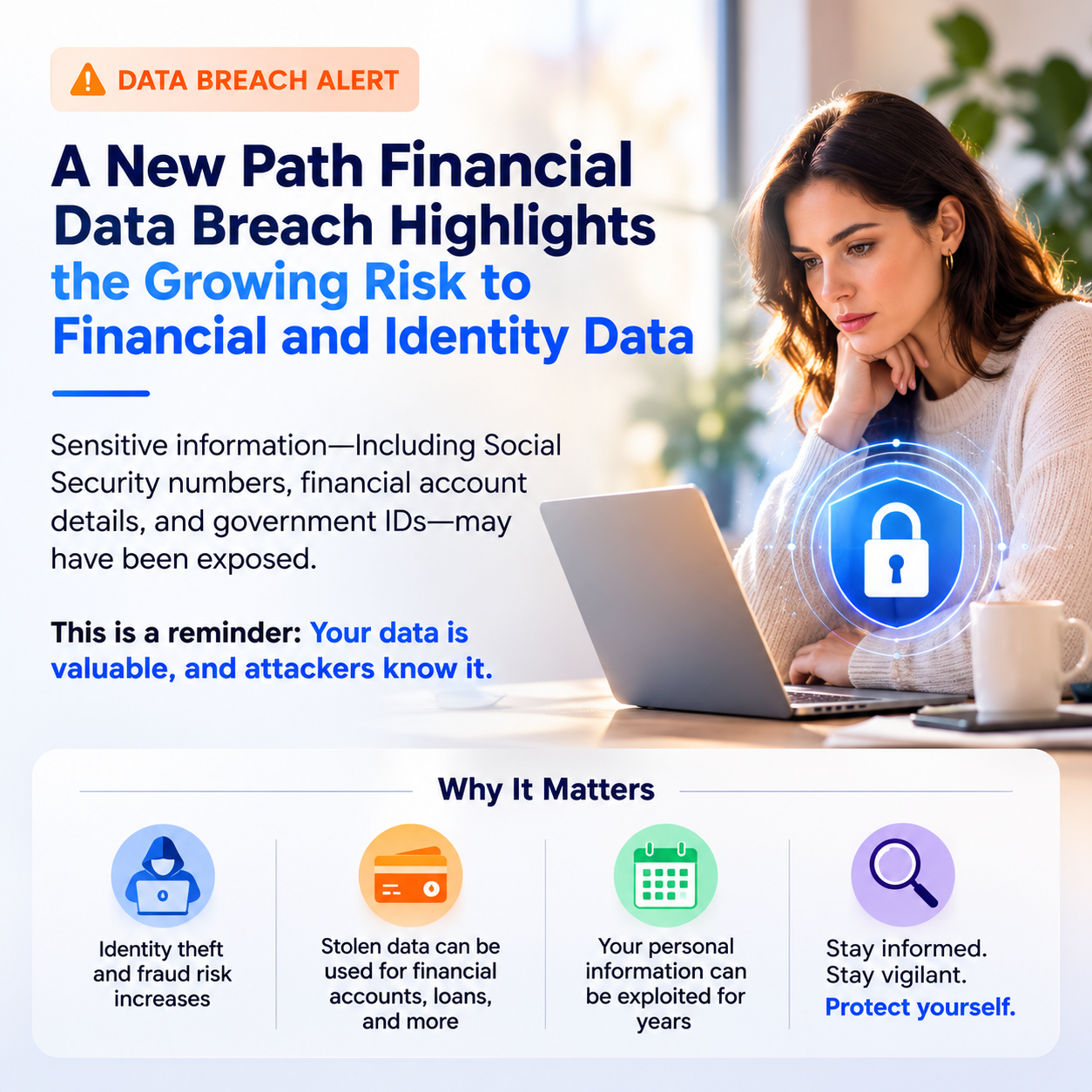
A New Path Financial, a financial planning and investment advisory firm based in Ann Arbor, Michigan, has notified individuals about a security incident that may have exposed highly sensitive personal and financial information.
According to the disclosure, the information potentially affected includes full names, dates of birth, current addresses, Social Security numbers, financial account information, and government-issued identification details.
The combination of these data elements makes this incident particularly concerning.
Why this breach matters
Not all data breaches create the same level of risk.
An exposed email address or username may primarily increase phishing and spam activity. However, when information such as Social Security numbers, dates of birth, government identification and financial account details is involved, attackers potentially have enough information to construct a much more complete identity profile of an individual.
Such information can potentially be misused for:
• Identity theft
• Fraudulent financial transactions
• Opening accounts using stolen identities
• Loan or credit applications
• Account takeover attempts
• Highly convincing phishing attacks
• Social-engineering attacks against financial institutions
• Tax or benefits-related fraud
Unlike passwords, which can be changed after a compromise, information such as a date of birth or Social Security number may remain associated with an individual for decades. This gives stolen identity information a considerably longer useful life for cybercriminals.
The incomplete incident timeline is also important
At the time of disclosure, publicly available information did not specify exactly when the security incident occurred, when unauthorized access began, when it ended, or when the organization first became aware of the activity.
This does not necessarily indicate anything improper, since breach investigations can take considerable time and disclosures may contain only information confirmed at that stage.
However, from a cybersecurity perspective, the absence of a clearly established intrusion timeline demonstrates an important challenge faced by many organizations: detecting exactly when an attacker entered the environment and determining everything they accessed while inside.
Attackers increasingly attempt to remain unnoticed rather than immediately disrupting systems.
A compromised environment may continue functioning normally while attackers quietly search servers, endpoints, shared folders, email accounts and databases for valuable information.
This makes visibility across the network extremely important.
Financial organizations face a particularly difficult challenge
Financial advisory companies may not operate the massive banking infrastructure associated with large commercial banks, but they can still maintain extremely valuable information.
Customer onboarding, financial planning and investment services may involve documents containing personally identifiable information, financial statements, identification documents, account details, correspondence and other confidential records.
The security challenge therefore extends beyond protecting one financial application or database.
Sensitive information frequently travels across multiple systems during normal business operations.
For example, customer information may appear in:
• Email attachments
• Employee laptops
• Shared network folders
• CRM platforms
• Financial planning applications
• Document management systems
• Cloud storage
• Scanned identity documents
• Backup infrastructure
• Third-party applications
• Temporary exports and reports
Organizations therefore need to understand not merely where sensitive information is supposed to reside, but where it actually travels.
Traditional perimeter security alone is no longer sufficient
Organizations historically concentrated heavily on protecting the network boundary.
Firewalls remain an essential security control, but modern attacks frequently begin through trusted communication channels, compromised credentials, vulnerable applications, remote-access systems or legitimate user accounts.
Once an attacker obtains access, the challenge changes.
The organization must be able to determine what that user, endpoint or application is attempting to access and whether the behaviour is consistent with legitimate business activity.
This is why cybersecurity strategies increasingly need to combine network security with contextual visibility.
Security systems should be capable of understanding:
• Who is accessing information
• Which device is being used
• What application is generating the traffic
• What type of information is being accessed
• Where that information is being transmitted
• Whether the behaviour is normal for that user
• Whether unusually large volumes of information are leaving the organization
Without this context, malicious activity can sometimes resemble perfectly legitimate network communication.
Data leakage prevention must therefore become part of the security architecture rather than simply an endpoint feature.
Segmentation can reduce the impact of compromised systems
Organizations handling financial information should also avoid allowing unnecessary communication between different systems and departments.
If one workstation or application becomes compromised, an attacker should not automatically gain unrestricted access to other sensitive parts of the environment.
Network segmentation and properly designed access policies can substantially reduce lateral movement.
Administrative systems, financial records, customer databases, employee devices and internet-facing services should be appropriately separated, with communication allowed only where required.
The principle should be simple: access should exist because there is a business requirement for it, not merely because two systems happen to be connected to the same network.
Credential security remains critical
Many modern compromises involve legitimate credentials rather than obviously malicious network traffic.
Organizations should therefore implement strong authentication practices, particularly for administrators, remote users and systems containing sensitive financial or personal data.
Multi-factor authentication, privileged-access controls, password policies and continuous monitoring for unusual login behaviour can significantly reduce the likelihood that stolen credentials become unrestricted access to the network.
Logging is equally important.
Authentication events, administrative activity, security-policy changes, unusual data transfers and access to sensitive systems should be recorded and retained for sufficient periods.
Without adequate historical logs, reconstructing an intrusion several months after it began can become extremely difficult.
Assume attackers may eventually get inside
A mature cybersecurity strategy should not be based solely on preventing every intrusion.
That is an admirable objective, but the internet has repeatedly demonstrated humanity's talent for clicking exactly the attachment security teams warned everyone about.
Organizations should therefore also design networks assuming that a user account, device or application may eventually become compromised.
The more important questions then become:
Can the attacker move freely?
Can sensitive information be accessed without detection?
Can large amounts of data leave the organization unnoticed?
Can unusual behaviour be identified quickly?
Can administrators reconstruct exactly what happened?
Security architectures built around these questions are significantly more resilient than architectures focused solely on blocking known attacks.
Affected individuals should remain vigilant
A New Path Financial is reportedly offering affected individuals 24 months of credit monitoring and identity-protection services.
Individuals receiving breach notifications involving Social Security numbers or financial information should take such notifications seriously.
They should monitor bank and credit-card statements, review credit reports for unfamiliar accounts or enquiries, remain suspicious of unexpected financial communications and be particularly cautious about calls, messages or emails requesting verification of personal information.
Attackers may use information obtained from one breach to make subsequent phishing attempts considerably more convincing.
A phishing message containing a person's real address, financial institution, date of birth or other personal details naturally appears much more credible than a generic scam.
The broader cybersecurity lesson
The A New Path Financial incident demonstrates why protecting sensitive information requires more than protecting servers.
Organizations need visibility into data itself.
They need to understand where sensitive information resides, who is using it, how it moves across the network and whether that movement is appropriate.
Firewalls, intrusion prevention, endpoint security, access controls, multi-factor authentication, network segmentation, data leak prevention and continuous monitoring should therefore operate as complementary layers rather than isolated security products.
The objective should not simply be to identify malicious files or known attacks.
It should also be to identify malicious behaviour occurring through otherwise legitimate applications and authenticated users.
When organizations understand the context surrounding network activity, they are considerably better positioned to identify unusual behaviour before a security incident develops into large-scale data exposure.
For organizations entrusted with financial and personally identifiable information, protecting the network ultimately means protecting the data flowing through it.

Data breach at A New Path Financial may involve personal and financial info. Steps to protect your data provided.
Source: A New Path Financial Data Breach Exposes Social Security Numbers via claimdepot.com.
Was this article helpful?
Your feedback helps us improve the knowledge base.