
The Bank of Baroda data breach highlights a serious risk in banking security: even when core banking systems are not directly compromised, customer data exposure can still create major fraud, privacy, and trust consequences.
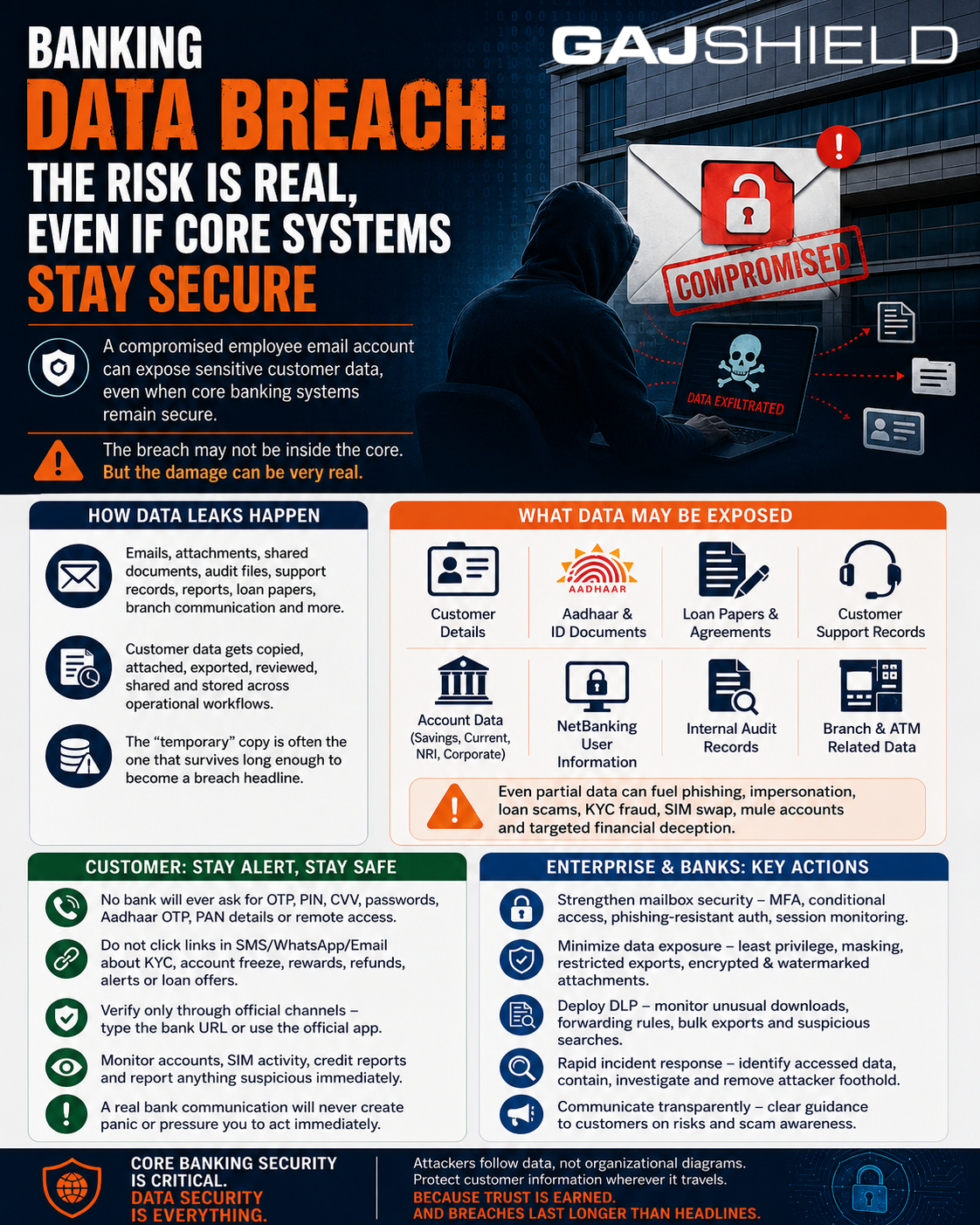
Bank of Baroda has reportedly stated that the incident involved the compromise of an employee email account, resulting in unauthorized access to certain data. The bank has also said its core banking systems were not accessed and continue to remain secure. That distinction is important, but it should not make customers or organizations treat the incident lightly.
A core banking system may remain untouched, yet sensitive customer data can still be exposed through email, attachments, shared documents, support files, audit records, loan papers, branch communication, customer-service records, or internal reports. Banking data does not live only inside the main banking application. It often gets copied, attached, exported, reviewed, approved, shared, and stored across many operational workflows. Naturally, the “temporary” copy is usually the one that survives long enough to become a breach headline.
The reported leak is especially concerning because it allegedly includes customer details, identification documents, loan papers, internal audit records, and other banking-related records. Some reports also refer to claims of Aadhaar details, savings and current account data, NetBanking user information, NRI and corporate banking records, customer support files, and branch or ATM-related documents.
Even if all reported categories are still being verified, the possibility of such data exposure is serious. Banking records are high-value identity data. Names, phone numbers, addresses, account references, Aadhaar details, loan documents, support history, branch details, and partial account information can be used for social engineering, impersonation, phishing, mule-account fraud, SIM-swap attempts, KYC fraud, loan scams, and targeted financial deception.
Customers should understand that attackers do not always need full account takeover data to cause harm. A criminal who knows a customer’s bank relationship, branch, loan status, account type, service request history, or identity details can create a very convincing scam. The caller may pretend to be from the bank, the fraud department, a KYC team, loan division, card department, RBI complaint cell, or cybercrime support desk.
This is where the real customer risk begins. After a banking data leak, customers may receive calls, SMS messages, WhatsApp messages, or emails that include real personal details. That does not make the communication legitimate. It may simply mean the scammer is using leaked data to sound believable.
Customers should be extremely cautious of anyone asking for OTPs, debit card numbers, CVV, UPI PIN, NetBanking passwords, Aadhaar OTPs, PAN details, remote-access app installation, screen-sharing, or payment to “secure” an account. No genuine bank employee should ask for OTPs, passwords, PINs, or remote access to a device.
Customers should also avoid clicking links in messages claiming urgent KYC updates, account freeze warnings, suspicious transaction alerts, reward points, refund processing, loan approvals, debit card renewal, or fraud verification. Any issue should be verified only through official bank channels, typed directly into the browser or accessed through the official app.
The involvement of a compromised employee email account is also a major lesson for enterprises. Email is not just a messaging tool. In banks and large organizations, email often contains attachments, approvals, spreadsheets, reports, identity documents, internal escalations, customer complaints, audit files, and operational correspondence. A compromised mailbox can become a data repository for attackers.
This is why mailbox security must be treated as data security. Organizations need strong MFA, conditional access, device compliance checks, phishing-resistant authentication for privileged users, session monitoring, impossible-travel alerts, suspicious inbox-rule detection, and rapid token revocation. A password reset alone may not be enough if attackers stole active sessions or OAuth tokens.
Banks should also review whether sensitive customer data is being stored or moved through email unnecessarily. Customer documents, Aadhaar records, loan papers, support exports, and internal audit materials should not sit casually in mailboxes for long periods. Email should not become a filing cabinet with a search bar and poor life choices.
Data minimization matters. Employees should access only the customer data needed for their role. Sensitive fields should be masked wherever possible. Bulk exports should be restricted. Attachments containing regulated or sensitive information should be encrypted, access-controlled, watermarked, logged, and retained only for defined periods.
DLP controls are also important. Banks should monitor for unusual attachment downloads, mailbox exports, forwarding rules, mass email access, suspicious search queries, access from unfamiliar locations, and bulk movement of customer records. A mailbox compromise should not allow silent extraction of large volumes of sensitive information without alerts.
Incident response should include more than containment of the compromised mailbox. The bank should identify what data was accessed, what files were downloaded, whether forwarding rules were created, whether tokens or sessions were abused, whether other accounts were targeted, and whether customer information has appeared on leak sites or criminal marketplaces.
If customer identity documents were exposed, the risk can last for years. Aadhaar, PAN, loan documents, address proofs, account details, and corporate banking records can be reused in future scams. Unlike a password, identity information cannot simply be reset. That is why breach impact must be measured not only by system access, but by the long-term fraud potential of the exposed data.
Corporate and NRI customers may face additional risk. Business banking records can support invoice fraud, vendor impersonation, fake payment instruction attacks, loan-document scams, trade-finance fraud, and targeted phishing against finance teams. NRI customers may be targeted with cross-border banking, tax, remittance, or account-freeze scams.
Bank employees should also be alert. After a breach, attackers may use leaked internal documents to impersonate executives, auditors, regulators, vendors, customers, or IT support. Internal familiarity makes phishing more believable. A scam email using real internal language, branch names, or audit references can bypass human suspicion more easily.
For financial institutions, the broader lesson is clear: customer data must be protected wherever it travels, not only where it originates. Core banking may be secure, but copies of customer data in email, reports, file shares, support tools, spreadsheets, and audit workflows can still create serious exposure.
Security teams should map data flows around customer information. Where is it exported? Who receives it? How long is it retained? Is it encrypted? Can it be forwarded? Can it be downloaded in bulk? Are access logs reviewed? Are stale files deleted? Are email attachments scanned for sensitive data? These are boring questions, which is usually how you know they matter.
Banks should also ensure rapid and transparent customer communication. Customers need clear guidance on what types of scams to watch for, what data may have been exposed, what actions the bank will never ask them to perform, and where to report suspicious communication. Vague reassurance may protect reputation for five minutes, but clear guidance protects customers.
Regulatory reporting, forensic investigation, customer notification, cyber insurance assessment, and law-enforcement coordination should all be handled with discipline. But from a security perspective, the most important follow-up is preventing exposed data from becoming fraud at scale.
Customers should monitor bank statements, UPI activity, loan-related communication, credit reports, mobile SIM activity, and unusual KYC requests. They should immediately report unauthorized transactions, suspicious calls, unexpected account changes, or messages asking for credentials or OTPs.
The key lesson is that email compromise in a bank can become a customer-data breach even if the core banking platform remains secure. Attackers follow data, not organizational diagrams. If sensitive records are stored in email or attached to operational workflows, that data becomes part of the attack surface.
Bank of Baroda’s incident should push every financial institution to review mailbox security, data-loss prevention, sensitive attachment handling, customer-document retention, access controls, and breach-response communication.
Banking trust depends not only on transaction systems, but on how customer information is handled across the entire organization. A secure core system is important, but it is not enough if sensitive data leaks through the side doors of daily operations.

Branch audit reports, loan appraisal files, vigilance records and customer account-opening forms are among the documents circulating online. The bank said its core banking systems were not accessed and has launched a forensic investigation.
Source: Bank of Baroda 1TB data breach linked to compromised employee email | Company Business News via livemint.com.
Was this article helpful?
Your feedback helps us improve the knowledge base.