
The growing exploitation of WP2Shell shows how quickly a critical WordPress core vulnerability can move from disclosure to mass scanning and active compromise.
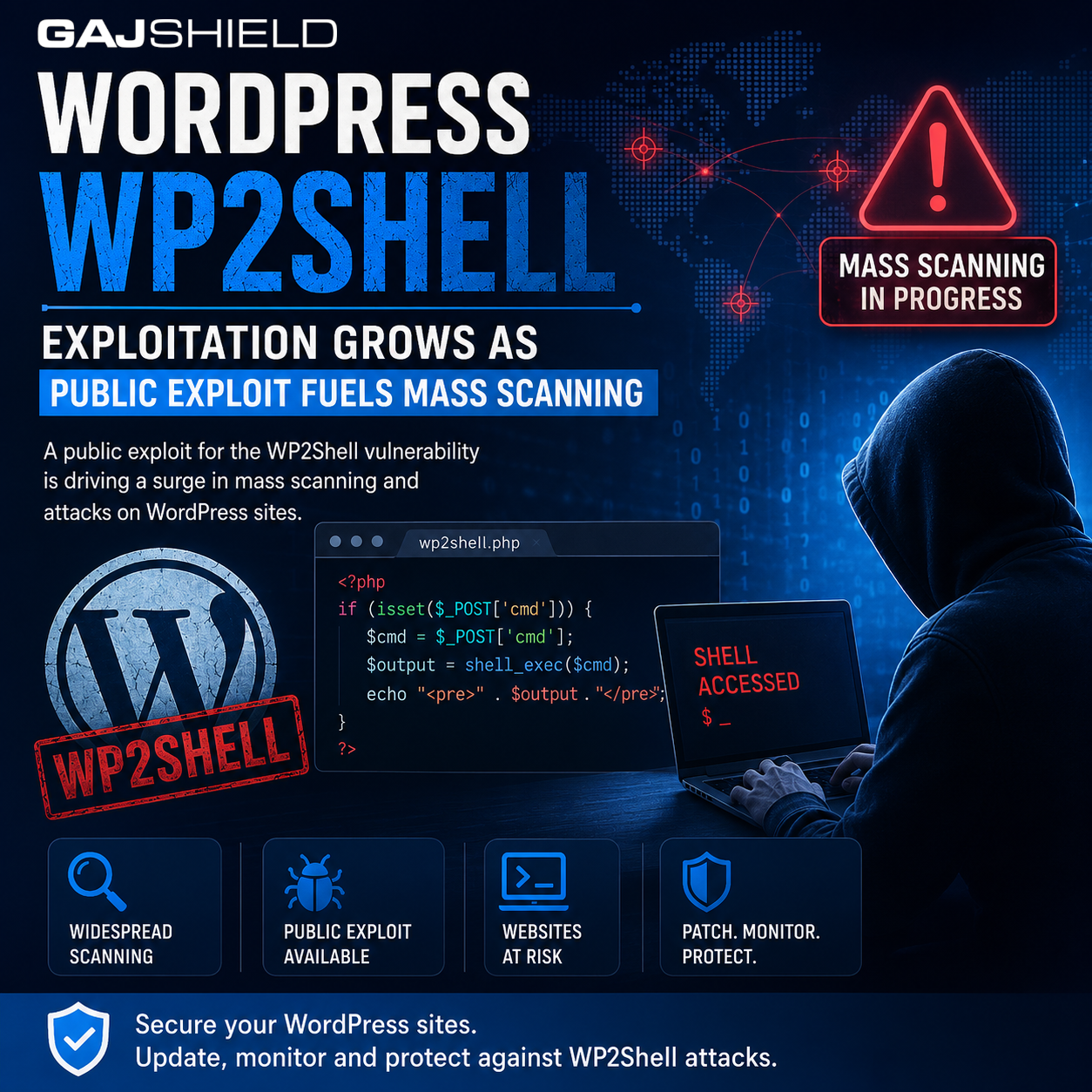
WP2Shell is not a typical WordPress plugin issue. It affects WordPress core itself and involves a chain of two vulnerabilities: CVE-2026-63030, a REST API batch-route confusion flaw, and CVE-2026-60137, a SQL injection flaw. When chained together, these issues can allow an unauthenticated attacker to execute code on a vulnerable WordPress site.
That is what makes this situation especially serious. The attack does not require a valid account, a compromised administrator, a vulnerable plugin, or a special configuration. Reports state that it can be exploited by an anonymous user against a stock WordPress installation with no plugins. For attackers, that is the kind of low-friction target they dream about, probably while ignoring every decent hobby available to them.
The newer exploitation activity is important because public exploit code has now fueled widespread scanning. Researchers have observed attackers initially using the bug to exfiltrate hashed credentials, with remote code execution attempts following as more details became available. This is a familiar pattern: first comes probing, then credential theft, then web shells, then persistence, then the charming chaos of mass compromise.
For organizations running WordPress, this should be treated as an urgent security incident, not a normal website maintenance task. Any vulnerable site exposed to the internet may already have been scanned. Sites that remained unpatched after public exploit availability should be assumed at elevated risk, even if there are no obvious signs of defacement or downtime.
Remote code execution on WordPress can lead to full website takeover. Attackers may upload PHP web shells, modify theme or plugin files, create administrator accounts, inject malicious JavaScript, redirect visitors, steal database contents, plant spam pages, host phishing kits, deploy malware, or use the server to attack other systems.
The business impact can be wider than the website itself. WordPress sites often connect to CRM platforms, payment plugins, marketing systems, analytics tools, email gateways, lead forms, customer portals, backup systems, and cloud storage. If attackers gain code execution, they may access configuration files, database credentials, API keys, SMTP passwords, OAuth tokens, and other secrets stored on the server.
Organizations should update WordPress immediately to the fixed releases provided by the WordPress project. Managed hosting providers should confirm that emergency updates were applied across all customer sites. Self-hosted users should verify the actual installed version, not assume auto-update succeeded.
Patching is necessary, but it is not enough if exploitation may already have occurred. After updating, administrators should perform compromise checks. They should review recently modified files, unknown PHP scripts, suspicious files in upload directories, unexpected administrator accounts, new plugins, modified themes, strange redirects, unfamiliar scheduled tasks, and changes to wp-config.php.
Security teams should review web server logs for unusual REST API requests, SQL errors, POST requests from unfamiliar sources, exploit-like payloads, suspicious user-agent strings, and repeated scanning activity. They should also inspect access patterns before and after patching, because attackers may have gained access before the update was applied.
Database review is also important. Attackers may create hidden users, alter site URLs, inject malicious content into posts or options, or extract password hashes and user data. If credential theft is suspected, WordPress user passwords should be reset, administrator accounts should be reviewed, and password reuse across other systems should be checked.
Secrets should be rotated where compromise is possible. This includes database passwords, FTP or SFTP credentials, hosting-panel passwords, SMTP credentials, API keys, cloud storage keys, payment plugin tokens, and any other credentials stored in WordPress configuration or plugin settings. Removing a web shell while leaving stolen credentials active is not remediation; it is tidying up after the burglar and leaving the spare keys on the table.
Organizations should also check backups. Clean backups should be identified from before the suspected compromise window. However, restoration should be done carefully, because restoring a vulnerable or already compromised copy may simply reintroduce the problem.
For hosting providers and agencies managing many WordPress sites, the risk is operationally larger. They should perform fleet-wide version checks, emergency patching, indicator searches, file-integrity scans, and customer notifications where compromise is suspected. Shared hosting environments should be reviewed carefully because one compromised site may expose neighboring sites if isolation is weak.
Web application firewall rules can help reduce exploitation attempts, but they should not be treated as the primary fix. WAF coverage may vary, bypasses may emerge, and attackers may adapt payloads. The core issue must be patched.
This incident also highlights why WordPress hardening needs to be continuous. Automatic updates should be enabled where practical. File editing from the WordPress dashboard should be disabled. Administrator access should be protected with multifactor authentication. Unused plugins, themes, and accounts should be removed. Upload directories should not allow executable code. File-integrity monitoring should be active.
For business-critical WordPress sites, segmentation is essential. The website should not have unnecessary access to internal databases, file shares, CRM systems, production APIs, or administrative networks. A public website compromise should not become a direct path into the rest of the organization.
The key lesson is that WordPress is not just a website builder. It is internet-facing application software with a massive global footprint. When a pre-authentication remote code execution chain becomes public, exploitation can move extremely quickly.
WP2Shell should push organizations to act with urgency: patch immediately, hunt for compromise, rotate exposed secrets, verify backups, and monitor for follow-on activity. Attackers are already scanning. Defenders cannot afford to treat this as another routine update waiting patiently in the dashboard.

Attackers have begun to exploit two critical vulnerabilities in WordPress that, when combined together, enable unauthenticated remote code execution (RCE) and complete compromise of vulnerable websites. The two security flaws, tracked as CVE-2026-63030 and CVE-2026-60137, have been codenamed wp2shell. "By the early hours of Saturday morning (UTC), successful exploitation was already well
Source: WordPress wp2shell Exploitation Grows as Public Exploit Fuels Mass Scanning via The Hacker News — published 21 Jul 2026.
Was this article helpful?
Your feedback helps us improve the knowledge base.